

10 Best Portable Electric Fence Energizers for Cattle (2026): Reviews & Buying Guide
Quick Answer: Which Portable Energizer Is Best for Cattle in 2026?
For rotational grazing on clean fence, a 1-joule solar unit such as the Gallagher S100 is the grab-and-go benchmark. For value, a dual-power charger with selectable output (2/3/5 joules, AC or 12V DC) delivers the most flexibility per dollar — the same box can power a spring calving paddock, a summer strip and a weedy fall run without buying a second unit. As a rule of thumb, cattle need at least 1 stored joule on clean fence, and 2–3 joules once weeds, bulls or multi-strand runs enter the picture.
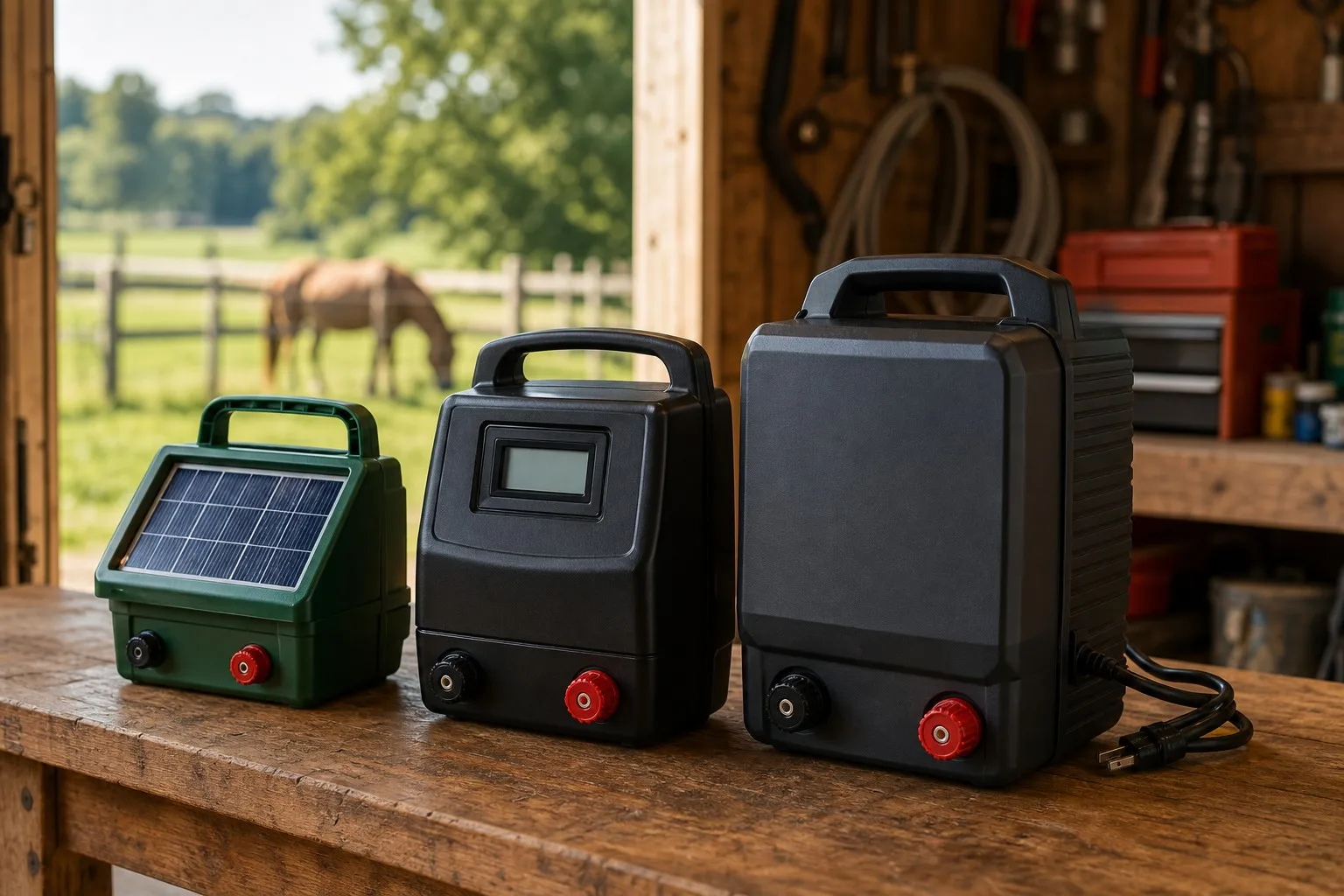
Why "Portable" No Longer Means "Weak"
Portable energizers used to be small solar boxes with a fraction of a joule — fine for calves for one summer, useless by November. That has changed. A modern 12V battery unit can push cattle-level joules down a mile of polywire, and the best solar packs keep a fence hot for two to three weeks of cloud cover.
Spec sheets still read like alphabet soup: stored joules, output joules, kilovolts, miles of fence, low impedance. Below we break down what each number means, then walk through ten portable units that make sense for cows, bulls and rotational grazing — including our own LIFEALL chargers, which we sell and can vouch for honestly.
Top 3 Picks (August 2026)
| Rank | Unit | Why |
|---|---|---|
| Editor's Choice | Gallagher S100 Solar | 1.0 J stored, 9-mile/30-acre range, runs ~3 weeks without sun, 3-year warranty. The rotational-grazing standard. |
| Best Value | Dual-power 2J/3J/5J charger (selectable output, AC/12V DC) | Adjustable output to 5 J, 8/10/12 kV, LED voltage display and fault alarm, IP65 shell — features that used to cost $300+. |
| Most Powerful Solar | Parmak Magnum Solar-Pak 12 | 3.1 J output, 30-mile solar rating, standard 12V battery. Proven for bulls on remote pasture. |
The 10 Portable Energizers Compared
| Unit | Output | Range | Power | Best For |
|---|---|---|---|---|
| Gallagher S100 Solar | 1.0 J stored | 9 mi / 30 ac | All-in-one solar | Daily paddock moves, clean wire, under 30 ac |
| Dual-power 2/3/5 J | 2/3/5 J selectable | 6.2 mi | AC or 12V DC | Growing herds, mixed livestock, adjustable needs |
| Parmak Magnum Solar-Pak 12 | 3.1 J output | 30 mi solar | Solar + 12V battery | Bulls, remote pasture, heavy weeds |
| Speedrite 3000 Unigizer | 3.0 J stored | 30 mi / 120 ac | AC or 12V DC | Established ops wanting a big-name warranty |
| Patriot P20 | 2.0 J stored | 20 mi / 80 ac | AC or 12V DC | Mid-size herds, sealed case, value line |
| Premier 1 IntelliShock 120 | 1.2 J output | 2.5 mi (3-strand cattle) | Solar, twin 12V batteries | Mixed cattle with sheep/goats/poultry, northern reserve |
| Cyclops Champion 2 J | 2.0 J | Conservative ratings | Solar or 12V | Storm-prone regions, fuse-protected repairs |
| Stafix X1 Unigizer | 1.0 J | 10 mi / 40 ac | AC or 12V DC | Small clean paddocks, simplest dual power |
| Zareba 10-Mile Solar (ESP10M-Z) | 0.15 J output | 10 mi solar | Solar, T-post mount | Weaning pens, short strips, hot wire inside barbed fence |
| LIFEALL 20-Mile Solar | High-output solar | 20 mi rated | All-in-one solar | Off-grid farms, perimeter + paddock use, longer seasonal runs |
How to Choose: The Three Numbers That Actually Matter
1. Joules — the Punch
Joules measure the energy stored in the capacitor before each pulse. For cattle: 1 J on clean fence is the floor, 2–3 J for bulls or weeds, 3 J+ for large multi-strand runs. Output joules are always lower than stored joules (usually 20–35%), and some brands quote one figure and some the other — compare output to output.
2. Voltage — the Pressure
Voltage pushes the pulse through hair and hide. 5 kV at the far end is the practical minimum for cattle; units peaking at 10–12 kV keep a margin when wet grass leans on the wire.
3. Miles — the Marketing Number
The miles rating assumes a single clean wire in perfect conditions. In reality, with three strands and weeds, expect about a third of it. Zareba publishes derated figures: its 25-mile AC charger does 12 miles in light weeds and 6 in heavy weeds — a lesson that applies to every brand.
Sizing by Herd and Fence


| Herd / fence | Minimum stored joules |
|---|---|
| Calves or a few cows, under 1 mile, clean | 0.5–1 J |
| 10–30 head, 1–3 wire miles, some weeds | 1–2 J |
| Bulls, 30–80 head, weedy multi-strand | 2–3 J |
| Large remote pasture, heavy vegetation | 3 J and up |
Why Adjustable Output and Monitoring Matter on a Portable
A fixed energizer is bought for one job; a portable one gets dragged into several. The same fence can need 1 J in June and 3 J in September. That is the case for a switchable unit, and it is why selectable-output chargers rank so high on value. Monitoring is the second separator: reading a voltage display from the truck beats walking the fence with a tester. A fault alarm that triggers on a broken line or dead short catches the failure before the herd does.
Grounding Still Decides Everything
Poor grounding is the number-one reason a new charger reads low — ahead of weeds and faulty units. Use one 3-foot rod for chargers under 1 J, and three 6-foot galvanized rods spaced ~10 feet apart for 2 J and above. Dry or sandy soil needs more rod. Measure at the far end of the line, not at the energizer; anything above 4–5 kV at the far end holds cattle. See our complete guide on how to ground an electric fence properly in the Guides section.
Frequently Asked Questions
How many joules do I need for bulls?
Plan on 2–3 stored joules with any weed contact, and 3+ on long multi-strand runs. Bulls test fences harder and carry thicker hide on the poll and neck.
Will a portable energizer work with electric netting?
Yes, but netting loads an energizer far more than polywire — a unit that powers 3 miles of polywire may only handle 4–6 rolls of netting. A 2 J or higher setting is safer for netting around cattle.
Does a higher voltage setting hurt cattle?
No. Energizers deliver a very short pulse; the joule figure controls energy delivered, not kilovolts alone. Higher voltage mainly helps the pulse cross thick winter coats and wet vegetation.
How do cold winters affect solar or battery units?
Lead-acid capacity falls roughly 20–40% below freezing and short days reduce solar recharge. Insulate the battery box, tilt the panel steeper for the low sun, and consider dual-power units you can simply plug into AC at the barn for winter.
How long should a portable energizer last?
The electronics in a decent unit run 7–10 years. Sealed internal batteries are the usual first failure at 2–4 years, which is why models with a user-replaceable 12V battery cost less to own long term. Lightning is the other killer — an external surge arrestor is cheap insurance.
Final Verdict
Match joules to wire miles, weed load and the animals, then size up by 20–30%. A charger running at 60% of its ceiling lasts longer and holds the fence through the one wet week when everything leans on the wire. If you are starting out or expanding, a dual-power unit with adjustable output avoids buying a second energizer next season — and if you want an off-grid solar option with honest range, take a look at the LIFEALL 20-Mile Solar charger in our shop.