

Goats Are the Houdinis of the Livestock World
Goats squeeze through gaps, leap over barriers and treat ordinary fences as suggestions. A 2021 survey of small ruminant farmers found that over 68% of goat owners reported at least one weekly escape incident before switching to electric containment. The good news: with the right setup — correct voltage, proper wire spacing, adequate joules and a quality netting system — the escapes stop for good.
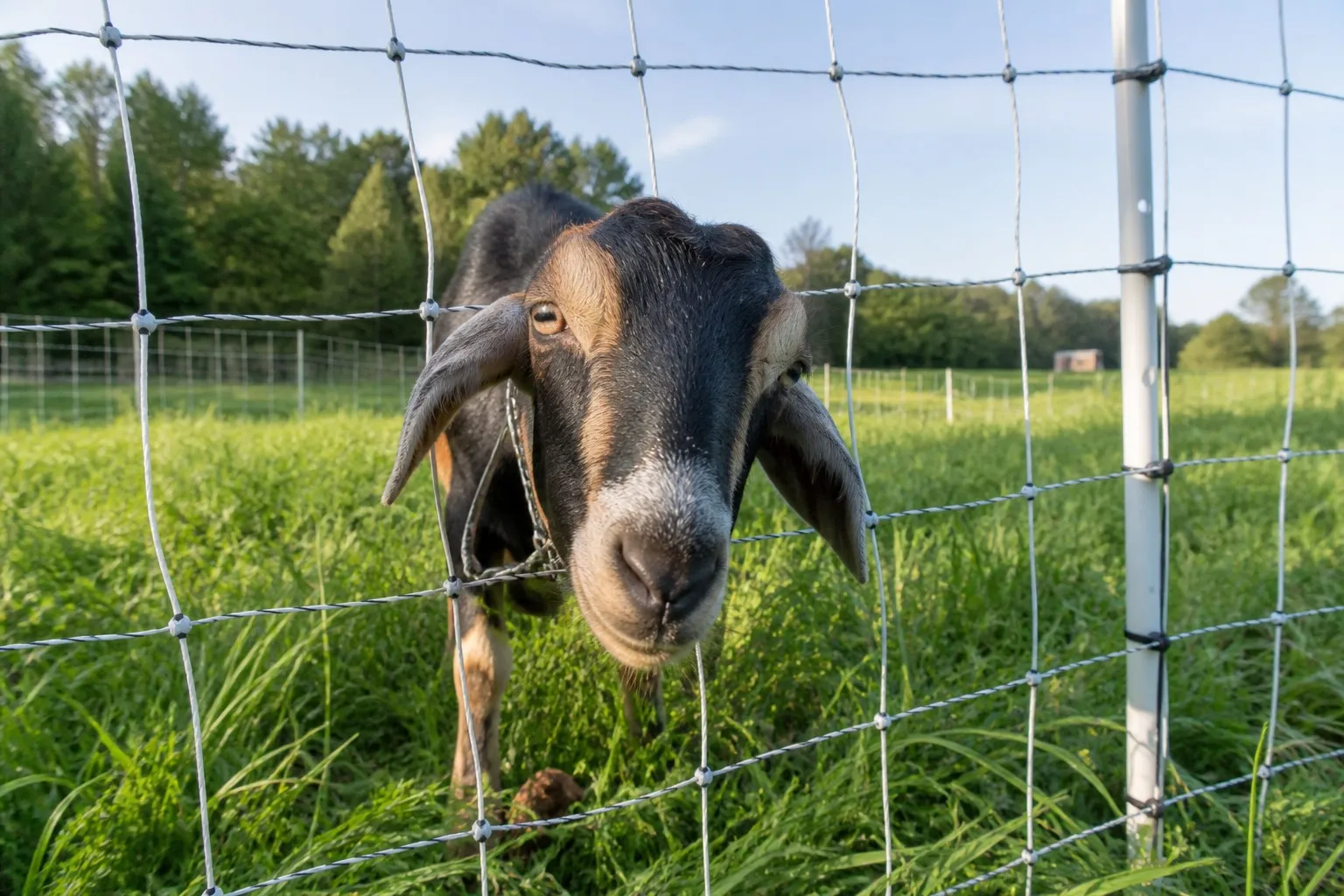
Why Standard Fences Fail
- Browsers, not grazers — goats eat at eye level and lean on fences to reach branches, damaging them.
- High pain tolerance and thick coats — weak shocks don't penetrate their winter coats.
- Horn physiology — keratin horns insulate, letting goats push or pull fences without getting shocked.
- Incredible agility — an adult goat can clear 4 feet from a standstill.
Research shows goats test fence integrity an average of 12 times per day. A fence that is only physical — without the psychological deterrent of a shock — will eventually fail. Electric fencing creates a conditioned avoidance response within 2–3 encounters.
The Core Requirements
| Parameter | Recommended for goats | Why it matters |
|---|---|---|
| Minimum voltage | 4,000–5,000 V on the line | Thick coats block weak shocks |
| Energizer output | 0.5–1 J (small herds); 2–5 J (large acreage) | More joules push through vegetation contact |
| Pulse frequency | 1 pulse/second (standard) | Gives the goat time to pull back, reducing entanglement |
| Wire height (multi-strand) | 6", 12", 18", 24", 36" from the ground | Deters crawling under, pushing through and jumping over |
Solution 1 — Electric Netting (Best for Rotational Grazing)
Electric netting is the gold standard for goat containment on homesteads and small farms:
- Zero squeeze-through room — tightly woven grids (roughly 3.5" × 6" near the bottom) mean a goat can't fit its head through, and horns can't tangle.
- Intense psychological deterrent — multiple conductive strands guarantee the investigating goat touches a live wire with its nose or ears.
- Predator protection — keeps coyotes, neighborhood dogs and bobcats out at the same time.
- Portability — a 164-foot section sets up and energizes in under 15 minutes, ideal for moving goats to fresh pasture.
For fence-jumping breeds like Boer goats, choose the taller (50") netting; 42" suits most standard breeds.
Solution 2 — Multi-Strand High-Tensile (Best for Permanent Perimeters)
Netting isn't practical for fencing a 50-acre boundary. For permanent lines, the standard is a 5–6 strand high-tensile electric fence — smooth wire, extremely strong, and it conducts electricity over massive distances.
Netting vs Multi-Strand: Which Fits Your Farm?
| Feature | Electric netting | Multi-strand high-tensile |
|---|---|---|
| Best use case | Rotational grazing, temporary paddocks, rented land | Permanent perimeter, large acreage |
| Installation time | ~15 minutes per 164-ft roll | Post driving, bracing, wire tensioning |
| Cost | Higher per foot, no tools needed | Lower per foot over long runs, high tool/labor cost |
| Predator protection | Exceptional | Very good with close spacing |
| Maintenance | Frequent moving or weed control beneath | Occasional tensioning and brush clearing |
Choosing the Energizer
The energizer is the heart of the system, and under-powering is the most common reason goat fences fail. Penn State Extension recommends sizing at double the fence length — vegetation, moisture and wire resistance all reduce effective output, so a fence testing at 3,000V at the energizer may deliver only 2,500V at the far end.
- Solar — remote pastures; needs adequate sun; the LIFEALL 20-Mile Solar covers mid-size operations off-grid.
- AC mains — most reliable and powerful for permanent barn-side fences.
- Battery/DC — portable; needs regular battery checks.
- Multi-power (AC + DC) — greatest flexibility; high-output models like our 9J charger handle large, high-vegetation lines.
Real-World Fixes
Three common patterns from farm case studies: a Tennessee farm with 14 Pygmy goats stopped twice-weekly escapes with a 5-strand electric wire fence on a 1-joule AC energizer, plus netting at the barn gate where escapes happened most. An Oregon Boer goat operation switched interior paddocks to portable netting on a solar energizer while keeping permanent electric wire on the outer boundary. A Texas hobby farm with Nigerian Dwarfs replaced wide welded-wire panels (newborns squeezed through) with fine-mesh netting and bottom-electrified strands.
Introducing Goats to the Fence
Turn the power on before the goats arrive, and let them learn at their own pace — most need only 2–3 contacts. Keep the line clear of vegetation, test the far end with a fence tester, and match volts to the animals' coats. For the full setup, work through our installation and grounding guides.